|
| . |
| Press Secretary | ||||||||
 |
Former Muntinlupa Mayor and Congressman Ignacio "Toting" Bunye formally assumed the post of Presidential Spokesperson on January 20, 2003. He previously held the position of the Press Secretary from July 16, 2002 to January 19, 2003. On August 24, 2004, he was again appointed as Press Secretary and concurrently as Spokesperson. A valedictorian during his elementary and secondary education, Bunye earned the degrees of Bachelor of Arts in Political Science and Bachelor of Laws from the Ateneo de Manila University. He also holds a Master’s Degree in Management from the Asian Institute of Management. Bunye, a lifetime member of the National Press Club, began his work in media as a working student at the Ateneo de Manila, first, as a reporter of DZMT, the radio station of the old Manila Times, and later, as reporter of the Daily Star. He was recently inducted as a member of the Manila Overseas Press Club. As a DZMT reporter, he covered the Vietnam War and wrote a documentary entitled "The Other War," a first person account of the activities of the Philippine Civic Action Group in Tay Ninh, South Vietnam. At the Daily Star, he wrote a number of articles, including a four-part series entitled "War Vignettes," a first-person account of events immediately after the Tet Offensive in South Vietnam in l968. A lawyer by profession, Bunye has served in various executive positions at the Ayala Group of Companies, including as Assistant Vice President of the Ayala Investment and Development Corporation and the Bank of the Philippine Islands. When former President Corazon Aquino assumed office after the EDSA People Power Revolution in l986, Bunye was designated Officer-in-Charge of the Municipality of Muntinlupa. He was duly elected as Mayor of Muntinlupa from l988 to l995. As Muntinlupa Mayor, Bunye served as Chairman of the then Metropolitan Manila Authority in a concurrent capacity, from l991-1992. In l995, Bunye was again reelected as Mayor of Muntinlupa for his last three-year term. During his 12-year stewardship, Muntinlupa metamorphosed from a fifth-class municipality into a highly-urbanized city. Adopting proven corporate practices that he gained from working in the private sector, Bunye streamlined operations and cut red tape, thus making Muntinlupa City the business-friendly community that it is today. He founded the Muntinlupa Polytechnic College, the city’s public college. Toward the end of his term as Mayor, Bunye laid the foundation for the establishment of the Ospital ng Muntinlupa through the acquisition of a five-hectare lot within the Filinvest Corporate City, which is also the site of the future Civic Center Complex. Barred by law to seek a fourth consecutive term as mayor, Bunye ran for Congress in l998 and became the first Congressman from the lone district of Muntinlupa City. In Congress, Bunye continued to champion the cause of local governments, especially in providing them with greater fiscal autonomy. Originally a member of the minority, Bunye became one of the fiscalizers of the 11th Congress. With the change of leadership toward the end of the 11th Congress, he became the Senior Deputy Majority Floor Leader. Bunye writes weekly columns for the Manila Bulletin (Speaking Out) and for People’s Journal, People’s Tonight and People’s Taliba (View From the Palace). Bunye is married to Dr. Miraflor Oca-Bunye and has three children. |
|||||||
| Mission | ||||||||
 The Official OPS Seal |
The Office of the Press Secretary is the primary policy planning, programming and coordinating entity of government for the conduct of a relevant and effective information and communications program. Its greater role is to develop people's understanding of government policies and programs as well as enhance public support and trust for such. | |||||||
|
||||||||
| History | |||||||
 The Kalayaan Hall |
In 1921, during the term of Gov.Gen. Leonard Wood, an Executive Building was built east of Malacanang Palace to house the offices of the Governor General on the first floor and to provide for guest rooms on the second floor. | ||||||
|
|||||||
| The OPS Proper has the following
units: 1. Presidential News Desk (PND); 2. Media Research and Development Staff (MRDS); 3. Electronic Data Processing Division (EDP) FUNCTIONS OF RANKING OPS OFFICIALS A. Undersecretary for Operations/Print 1. Assist the Press Secretary in the planning, implementation and evaluation of policies, plans and programs relating to activities and print media operations; 2. Exercise first line supervision over the operations of the following bureaus
He shall also exercise supervision over the Journal Group of Publications, a sequestered media entity, for which he shall be responsible to the Press Secretary. He shall likewise supervise the Presidential News Desk (PND), the Foreign Information Council (FIC), the Presidential Message Staff (PMS), News Photo Section, and the Media Research and Development Staff (MRDS); 3. Supervise the monitoring of news and information affecting the Presidency and the Government and recommend necessary measures to ensure that positive feedback is strengthened and the negative ones, clarified or nullified; 4. Develop and formulate a comprehensive communications plan for the government; 5. Assist the Press Secretary in the formulation and implementation of Office objectives and policies within his line of authority; 6. Coordinate the programs and projects of the Office and shall be responsible for its economical but efficient and effective administration; 7. Serve as deputy to the Press Secretary in all matters relating to the operations of the Office within his line of authority; 8. Perform such other functions as may be assigned by the Press Secretary from time to time. B. Undersecretary for Media Relations 2. Take responsibility in providing assistance to media representatives on matters relating to the activities of the President, including the policies, programs and activities of the Government; 3. Exercise direct supervision over the operating units for which he shall be responsible to the Press Secretary, namely:
4. Monitor daily press and photo
releases issued by the PND which are used by 5. Perform such other functions as may be assigned from time to time by the Press Secretary. C. Assistant Secretary for Operations 1. Assist the Press Secretary in the planning, evaluation and implementation of policies, plans and programs relating to broadcast media operations nationwide, under the overall supervision of the Press Undersecretary for Operations 2. Exercise first line supervision over the news operations, information dissemination and documentation undertaken by the following agencies:
3. Exercise policy supervision over NBN-4 including the sequestered television networks RPN-9 and IBC-13, for which he shall be responsible to the Press Secretary. 4. Exercise supervision and control over the Electronic Data Processing (EDP) Divsion, including its website and related information technology operations. 5. Oversee the IT development programs of the OPS, particularly the French Protocol Project, under the supervision of the Undersecretary for Operations. 6. Perform such other functions as may be assigned by the Press Secretary or his deputies. D. Assistant Secretary for Legislative Affairs 1. Assist the Press Secretary in closely networking with the officers and members of the Senate and the House of Representatives and thus provide a forum for coordination and mutual support on legislations related to public information; 2. He shall establish linkages with other government agencies and instrumentalities pertaining to vital public information dissimination programs of the Administration. 3. Perform such other related functions as may be assigned to him by the Press Secretary. E. Assistant Secretary for Administration and Finance 1. Assist the Press Secretary in the planning, implementation and evaluation of policies and standards for an efficient, effective and cost-control oriented administration pursuant to the objectives of the Office; 2.Exercise first line supervision over the administrative and financial operations of all operating units and bureaus under the Office of the Press Secretary; 3. Exercise supervision over the Administrative and Fiscal and Management Services in the OPS-Proper, for which he shall be responsible to the Press Secretary; 4. Perform such other functions as
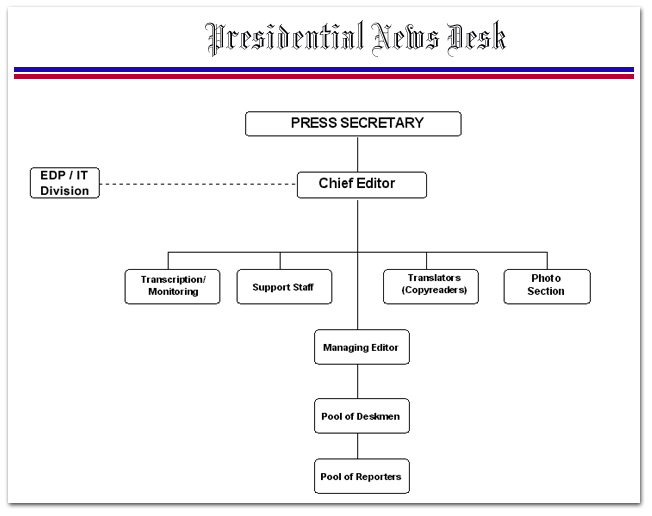
may be assigned by the Press Secretary from time to time. The Presidential News Desk (PND) functions as a full-fledged newsroom under the Office of the Press Secretary (OPS). As the news gathering and dissemination arm of the presidency, the PND issues, on a daily basis, official press and photo releases, as well as official statements of the President, the press secretary, and the presidential spokesman. It also issues Balitang Malacanang, a translation of our official English releases. From time to time, the PND also issues press releases on other government agencies whose activities are in line with policies and programs enunciated by the President, more specifically on her 10-point agenda for development. The PND releases an average of 10 stories a day; the volume of releases depends on the activities of the President and her Cabinet. It also issues photo releases on official functions of the President and her immediate official family. The PND operates 15 hours a day, seven days a week, from 5:00 a.m. to 7:00 p.m., Monday to Sunday (including holidays). Headed by a chief editor, the PND staff is composed of a managing editor (who is also the city editor), a pool of deskmen and reporters (please see attached organizational chart). Other OPS administrative and technical units support PND operations. These include the EDP (responsible for developing and maintaining the OPS website), Transcription/Monitoring Unit, and the Photo Section. The PND mainly serves the editorial needs of the Malacanang Press Corps. But through our website (ops.gov.ph), our official issuances are also being accessed to by local and foreign wires agencies, radio and television stations, the diplomatic community, business groups and individuals both here and abroad, overseas Filipino workers (OFWs) and others. Community newspapers and radio stations nationwide also get our releases through our website or through the Philippines News Agency. Our website is being visited by an average of 20,000 individuals or groups daily, a bigger readership audience than that of most newspapers in Metro Manila. Since its inception in the early seventies, the PND has always been directly under the Press Secretary. During martial law, when Francisco Tatad was the press secretary, who was later replaced by Gregorio Cendana, the PND was then called the Central Desk. It used to hold office at the Mabini Building. After the February l986 EDSA uprising, when Press Secretary Benigno Teodoro took over during the Cory Aguino presidency, the Central Desk was downgraded to a mere section of the Presidential Press Staff (PPS), then called News and Reportorial Section (NRS). When former President Fidel R. Ramos took over, then Press Secretary Rodolfo Reyes strengthened the presidential coverage and set up what is now known as the PND.
|
|
| . | |
| Contact: Secretariat, (632) - 7333624, 7338674 | |
| [TOP] [AGENCIES] | |
| In 1986, a
government-wide reorganization was effected which abolished Office of Media
Affairs-National Media Production Center (OMA-NMPC) among others to streamline government
bureaucracy and redirect and reorient the government information system. The Philippine Information Agency (PIA) was then formed
out of the defunct OMA-NMPC through Executive Order No. 100 promulgated on Dec. 24, 1986. Under the new orientation and thrust of the government, the PIA mission is geared towards creating conditions that will allow the free flow of accurate, timely and relevant information to and from the Filipino people. The goal is to create an enlightened citizenry which can participate meaningfully in democratic processes. The PIA is organized into 11 divisions, 15 regional information offices, 74 provincial information centers, 911 community development information centers (CDIC). The present organization of PIA followed the same pattern as that of OMA-NMPC except for the establishments of CDICS. But PIA's information efforts are now geared to development communication goals rather than propaganda, image building and media control. PIA information centers serve as access centers on information particularly on government programs, projects and policies. They serve as one-stop shops which ensure two-way flow of communication between the government and the people. This nationwide network is the focal point for disseminating information on government programs and gathering of feedback on popular opinions, people's aspirations and expectations. The Motion Pictures Division/Film Laboratory is considered a leading one-stop shop for film processing in the country. The Public Opinion Polls Division monitors the public pulse with respect to government programs and policies. The Media Studies Division, another research arm, conducts regular media monitoring and content analysis studies on government issues as perceived by columnists/editors as well as studies on media infrastructure, and access to information. It publishes communication monographs, Philippine Media Factbook, Media Profile, government directory, facts and figures. Results of studies are used as data base for policy formulation, project development and evaluation. The Media Infrastructure Division and Human Resources Development Division have looked after the broadening of people's access to media and the upgrading of skills and ethical standards among communication personnel, particularly those in government. Training programs and values orientation seminars are held for communication personnel and services in the PIA as well as in other government and non-government organizations. In the ICON, the PIA is the lead agency in the region in line with the policy for strengthening information coordination among the different line departments in the countryside. In the same spirit, PIA is an active member of other government organizations such as the PROP, RDC, AGPIO, AREX and its regional counterparts with an estimated outreach of 40% or 24 million of the total population. The PIA has also established working relationships with international organizations like the ASEAN Committee on Culture and Information (COCI), UNICEF, UNESCO, Asian Mass Media Information Center, Institutional Development Research Center, WHO, JICA, UNDP, IRRI and UNHCR. PIA undertakes information related projects for these agencies. |
| Contact: Director General Conrado Limcauco Jr. |
| Telephone Numbers: (632) - 9204386, 9204345 |
| [TOP] [AGENCIES] |
| The Bureau of Communication
Services (BCS) conceptualizes and implements programs that project the activities,
policies, and directions of the overnment in general, and the presidency in particular. In
the 1989 review of agency mandates, the BCS was directed to "provide services
relating to policy formulation, communication planning, project development, research and
evaluation, creating and production functions, coordination of information dissemination
for the OPS and its bureaus and attached agencies." The Bureau conducts polls and surveys that serve as inputs to policy formulation, communication planning services, production and printing of information materials for special events such as EDSA anniversary, Independence Day, Alay Lakad, state visits and other state events. It also has its own in-house publications. |
| Contact: Dir. Leo Alcantara |
| Telephone Number: (632) - 7342119 |
| [TOP] [AGENCIES] |
| The Presidential Broadcast
Staff (RTVM) is an attached agency of the Office of the Press Secretary. It is tasked
primarily with the video and audio documentation of the President's daily activities.
Operating 24 hours daily, seven days a week, it also provides the President's office with
prompt and efficient broadcast services. RTVM was organized on July 16, 1986. Thrusts The Presidential Broadcast Staff continues to create the broadest public awareness of the efforts and measures undertaken by the President toward national development; provides mechanisms for public interaction with the President that allow and encourage people's participation in the discussion and resolution of issues relating to their community, municipality, city, or province, as well as other of national concern. RTVM is the first media institution in government that has provided, and continues to provide, regular television and radio coverage programs throughout a President's term, thereby setting a precedent and standard by which succeeding administrations may assess the extent and depth of private media's access to the Executive Branch. RTVM has successfully laid the foundation for expanded Presidential archives that includes the most modem media forms (magnetic tapes and laser discs). The staff maintains complete audio and video archives of Presidential activities, as well as major governmental programs of the last eleven years: a rich lode on Philippine Government Data preserved for posterity in state-of-the-art technology. RTVM also pioneered in mobilizing private broadcast media to reinforce broadcast media coverage of Presidential activities and major state events. Through the establishment of the Philippine Broadcast Pool (PBP), private and public sector media continue to cooperate and strengthen each other's information gathering and dissemination capability by sharing their material, technical and human resources. The staff also undertakes regular radio-television programs on the Presidency, presidential activities and current issues. These are shown weekly or monthly. RTVM likewise contributes to the development of Philippine radio and television as a whole, specifically, in its information and educational aspects. Special features on topics of national significance and documentaries on historical themes conceptualized and executed by the Staff have won widespread acceptance. |
| Contact: Director Milton A. Alingod |
| Telephone Number: (632) - 7422371 local 6001, 6002 |
| [TOP] [AGENCIES] |
| Primarily, Bureau of
Broadcast Services (BBS), as a radio network, exists to reach the audiences that
private broadcasters are not interested in. From only 14 stations of 1-kilowatt average
power rating output in 1986, the government radio facility is now a network of 34 radio
stations nationwide with an average power output rating of 10 kilowatts. Its stations in
Manila, Cebu and Naga operate on 50 kilowatts output ratings. In terms of audience reach,
where in 1986, government radio reached only 25% of the total population, now its reach is
50%. The BBS continuously provides accurate and objective information and undertakes communication strategies that help bring the government closer to the people. News and public affairs have always been the centerpiece of its programming operations. Cultural and educational features complete a well-balanced fare for the BBS audience. Production work has been dedicated to accuracy, clarity and objectivity. However, as a matter of policy, emphasis is placed on broadcast materials that promote awareness of official government activities, projects, priorities, including regular presidential, pronouncements, legislative concerns, and virtually every single important event in the various agencies and instrumentalities of government that are addressed to the public welfare. Radio Network BBS has a vast radio network that reaches the whole nation with a collective transmitting power of 406.50 kilowatts. It has four Metro Manila stations namely: DZRB-Radyo ng Bayan, DWBR-the Business Radio, DZRM and DZFM Sports Radio and 30 provincial stations that are committed to serve the development thrusts of the government. Of the 34 BBS stations, 30 are AM stations and 4 are FM stations. Twenty-one (21) stations have ten (10) kilowatt power output, three (3) have 50 kilowatt power output, four (4,) have one (1) kilowatt power output, one has 25 kilowatt power output and two, 0.25 kilowatt power output on FM. Many of the locations served by the BBS has a radio station for the first time, other areas have been abandoned by private radio stations. Thus, in order to be an effective and responsible instrument of development, BBS steadily evaluates its radio programs and subsequently institutes the necessary changes in form and substance. Personnel undergo continuing programs to enhance their skills while equipment and facilities are regularly upgraded. |
| Contact: Director: Rafael Dante A. Cruz |
| Telephone Number: (632) - 9203968 |
| [TOP] [AGENCIES] |
| The National Printing Office
(NPO) is a creation of Executive Order No. 285 dated July 25, 1987. The said
E.O. abolished the General Services Administration (GSA) and transferred its functions to
appropriate government agencies. In answer to the need for an effective government
printing and publication system the relevant printing units of the Philippine Information
Agency (PIA) were merged with the Government Printing Office which was then an agency of
the GSA resulting in the creation of the NPO. NPO is mandated by Executive Order No. 285
with the exclusive printing jurisdiction of government standard and accountable forms, the
official ballots, public documents and development information materials. PIA was subsequently placed under the supervision and control of the Office of the Press Secretary under Administrative Order No. 49 dated November 20, 1987 thereby making NPO an attached agency of OPS. NPO had 36 printing machines in operation in 1986, out of a total of 65 consisting mostly of pre-war vintage printing machines. The latest acquisition was in 1979. With the rehabilitation program initiated in 1990, it has now a total of 52 machines in operation including the merged printing units. Although Executive Order No. 285, was issued on July 25, 1987 mandating the National Printing Office with exclusive printing jurisdiction on the printing, binding, and distribution of all standard and accountable forms, among others, it was only during the middle part of 1990 that the new management has fully complied with the mandate of E.O. No. 285 and started instituting changes. The NPO management concentrated on the printing of standard and accountable forms after a nationwide survey has been conducted to determine the demands of said forms, thereby enabling this Office to program its projects and activities in proper operational perspective. |
| Contact: |
| Telephone Number: (632) - 9252187 |
| [TOP] [AGENCIES] |
| Television is the most
effective medium for relaying messages to various publics and the People's Television
Network (PTV-4) is proud to be on the air to bring news and information to the nation.
PTV-4 is doubly proud to be present and serving right from the start - on February 24,
1986 - the third day of the EDSA Revolution. The station was on the air bringing much
awaited news to an information-hungry Filipino nation. Immediately upon taking over a heavily damaged broadcast facility, the People Power volunteers found an MBS-4 looted of equipment, with no program inventory, and with only one hundred fifty-four pesos (Pl54.00) left in cash from a 1986 budget of sixty million pesos (P60M) and a few millions in debt. Worse, it had no official standing and no organization structure. There were only employees and equipment to do Malacaņang's bidding. Even the employees had no tenure. The new PTV-4 was able to rise, phoenix-like, from the ruins of its predecessor, and in the span of six years, achieved many things. PTV-4 has never been, officially, a government station. No money from the national government has even funded the station. PTV-4 has never had any allocation in the General Appropriations Act. All its funds are self-generated. Innovative Public Information
From an MBS-4 with poor ratings, a small outreach and looted-of-equipment network in 1986, PTV-4 now ranks among the top networks in terms of nationwide reach and coverage. The Network embarked on a Facilities Upgrading Project with assistance from the French Government. Under the Second and Third French Protocols of 1990 between the Philippine and French Governments, PTV-4 was recipient of FF74.2 million (P28 M) in the form of transmitter facilities, studio, video and audio equipment. PTV-4 now broadcasts from its new headquarters at the Philippine Information Agency compound in Visayas Avenue, Quezon City. PTV-4 launched its satellite-simulcast broadcast programming last February 14, 1992 for nationwide outreach. With the acquisition of the uplink equipment to match the Transponder 54 of the Palapa B2P Satellite lease from Telkom, Indonesia, PTV-4 operates on a full-time satellite broadcast 24 hours a day. Programming is 11 % News: 13% Public Affairs; 16% Educational; 19% Sports; 36% Entertainment and 5% Religious. |
| Contact: Gen. Manager : Jose S. Isabelo |
| Telephone Numbers: (632) - 9204389, 9215081 |
| [TOP] [AGENCIES] |
| The News and Information
Bureau (NIB) is composed of the following divisions: 1) Administrative and Financial
Division; 2) Presidential Press Staff; 3) Media Accreditation and Relations Division; 4)
Philippines News Agency. The Administrative and Finance Division attends to the general
administrative and financial requirements of the Bureau and its line/operating divisions. The Presidential Press Staff documents all of the utterances of the Presidency primarily for print media. A team of reporters join the Malacaņang Press Corps in its interviews to provide a permanent record of whatever took place. The PPS reporters transcribe speeches and write out the necessary news reports, which form the basic documents of a particular event. Under the PPS is the Clipping Section which organizes all articles, columns and editorials on the Presidency. The Media Accreditation and Relations Division, has two sections under it namely: Media Accreditation and Relations Office (MARO) and the International Press Center (IPC). The Media Accreditation and Relations Office handles media coverage arrangements of Presidential events, both here and abroad. Its Media Relations Officers make sure that media has a proper place in these events. They accompany media during out-of-town coverages, making sure that they have transportation and facilities for covering the events. The International Press Center accredits foreign and local media whose IPC identification cards help them to cover individual officials and to enter events that are open for coverage. Although there has been some criticism from foreign advocates of Press Freedom, the arrangements that the IPC has made, including their helping foreign media to get their working permits from the Bureau of Immigration and Deportation, their helping them in the event that they have to deal with the policy on coverage matters and facilitating the entry of equipment through the NAIA has been favorably accepted and even endorsed by the foreign media who are working here. The Philippine News Agency (PNA), provides daily news service to both local and foreign publics. The PNA has been transformed from a government propaganda arm to a professional news agency. It underwent reorganization to improve and professionalize news service delivery to its various media clients. The Agency has a 24-hour computer-linked news exchange arrangement with 24 other news agencies in ASEAN and the Asia-Pacific region. The swapping of news, features, and special reports is part of the multilateral agreement among members of the ASEAN News Exchange (ANEX) and the Organization of Asia-Pacific News Agencies (OANA). ANEX comprises ANTARA of Indonesia, BERNAMA of Malaysia, the TNA of Thailand and the PNA. Although Brunei Darussalam and Singapore have no national news agencies, some of their media facilities are linked to the ANEX system through BERNAMA, the regional communications center of the exchange. OANA is a broader international news exchange framework which includes, among others, KYODO of Japan, YONHAP of South Korea, PTI and UNI of India, XINHUA of China, VNA of Vietnam, AAP and PPI of Pakistan, KPL of Laos, KCNA of North Korea, LANKAPUVATH of Sri Lanka, MONTSAME of Mongolia, IRNA of Iran, RSS of Nepal, TASS of Russia and ANADOLU of Turkey. |
| Contact: Asec. Jose Capadocia |
| Telephone Numbers: 733-1611 |
| [TOP] [AGENCIES] |
 |
||
OFFICE OF THE PRESS SECRETARY |
||
|
3rd Flr. New Executive
Bldg., Malacaņang Compound |
||
| Hon. IGNACIO R. BUNYE | Press Secretary | 734-5929 |
| bunye@ops.gov.ph | ||
| Hon. ROBERT T. RIVERA | Undersecretary for Operations | 735-6201 loc. 6916 |
| Hon. JOSE CAPADOCIA | Undersecretary for Media Relations | 734-7419; 733-3742 |
| 735-6192 F | ||
| Hon. MARTIN ANTONIO S. CRISOSTOMO | Undersecretary for Special Concerns | 733-3624 / 733-8658 |
| Assistant Secretary for Presidential Events | ||
| Hon. CORNELIO M. BALIAO JR. | Assistant Secretary for Administration & Finance | 734-7420 (F) 734-7420 |
| DARIO F. MAGSADIA | Officer-in-charge | 734-5922 (F) 733-8679 |
| Administrative Service | ||
| TOMAS EMERITO MAGDANGAL | Officer-in-charge | 734-7417 (F) 734-5966 |
| (OIC) | Fiscal Management Service | |
| DIVISIONS/SECTIONS | ||
| EDNA G. CUEVA | Officer-in-charge | 733-3668 |
| General Services Division | ||
| AIDA TURLA | Chief | 733-3668 loc 6904 |
| Personnel Section | ||
| DOMINADOR UBAS | Chief Accountant | 734-5885 |
| Accounting Division | ||
| MA. ALMA A. FRANCISCO | Officer-in-charge | 734-5966 |
| Budget Division | ||
| MA. CECILIA N. JAVILLONAR | Officer-in-Charge | 733-8679; 733-3726 |
| Media Research & Development Staff | ||
| SEVERINO SAMONTE | Editor-in-Chief | 733-3632; 733-3119 |
| Presidential News Desk | ||
| JOSE L. OGRIMEN, JR. | Chief | 733-1204 |
| Electronic Data Processing Division | jun@ops.gov.ph | |
BUREAUS/ATTACHED AGENCIES |
||
| BUREAU OF BROADCAST SERVICES | RAFAEL DANTE A. CRUZ | |
| 4/F PIA, Visayas Avenue, Diliman, Quezon City | Director | |
| 920-3968; 921-2524; 924-3717 F | dante-a-cruz@hotmail.com | |
| BUREAU OF COMMUNICATION SERVICES | LEO ALCANTARA | |
| Philippine Cancer Society Bldg., | DIRECTOR | |
| San Rafael St., San Miguel, Manila | bcsodir@info.com.ph | |
| 734-2119 TF; 734-2118 TF; 734-2120 | ||
| NATIONAL PRINTING OFFICE | FELIPE P. EVARDONE | |
| EDSA cor. NIA Northside Road, Diliman, Quezon City | OIC Director | |
| 925-2187 to 88 | ||
| NEWS AND INFORMATION BUREAU | JOSE CAPADOCIA | |
| OPS News and Information Bureau Bldg., Malacanang, Manila | DIRECTOR | |
| 733-1611; 733-1703; 733-1732; 733-1613 TF | ||
| PHILIPPINE INFORMATION AGENCY | CONRADO LIMCAOCO JR. | |
| PIA Bldg.,1100 Visayas Avenue Quezon City | Director General | |
| 920-4386; 920-4347 F; 920-1224; 921-7941 | ||
| RADIO TELEVISION MALACAņANG (RTVM) | MILTON A. ALINGOD | |
| RVTM Bldg., Gate 7, Malacaņang Palace | Executive Director | |
| 735-6186; 733-5686; 735-6175 TF | execrtvm@info.com.ph | |
| 819-5854; 819-5855; 815-2168 F | ||